By Barika Phillips-Bell, Co-Founder | COO – B3 Media Solutions, Inc. Results as of Nov 17, 2026, 10:30 AM PT, unofficial pending state certification.
Key takeaways
- We asked seven AI models to make 56 locked predictions on four 2026 U.S. Senate races. Fifty-five picked the candidate the Associated Press later projected as the winner. The one miss was Gemini’s no-poll Texas run, which leaned Paxton at 52%.
- In Nebraska, a tied YouGov poll still produced 14 answers favoring the incumbent. That is the same habit that produced 14 misses in our Los Angeles mayor’s race.
- The models were most confident where it mattered least (North Carolina, average 87.9% on a race unofficially at about +19.7) and least confident where the margin surprised (Texas, average 56.9% on a race unofficially at about +12.1).
- Five of 14 Michigan answers used a November 1 endorsement that sat outside the October 1–31 prompt window. The leak did not change the call.
- All four vote shares are still unofficial. North Carolina is scheduled to certify on Nov 24, Michigan on Nov 23, Nebraska on Nov 30, and Texas in a state canvass window of Nov 21–Dec 7.
Did AI predict the 2026 Senate races correctly?
Getting the call right is not the same as being right. In Round 2 of our AI election experiment, seven AI models made 56 locked predictions on four U.S. Senate races — North Carolina, Texas, Nebraska and Michigan — on November 2, the day before the election. Fifty-five of the 56 picked the candidate the Associated Press later projected as the winner. The one miss was a single Gemini answer in Texas that leaned Paxton at 52%.
I know it reads like a clean win for AI, but we don’t think it is, for three reasons. In Nebraska, the models got it right using the same habit that sank them in the Los Angeles mayor’s race. In Texas, they were least sure in the race that ended with the widest margin of the three close contests. And in Michigan, five answers quietly used information they were told not to use, and the scoreboard would never have told us.
This is the Senate follow-up to our Los Angeles mayor piece, “Fourteen AI Answers Agreed on the 2026 LA Mayor’s Race. That Was the Problem.” The method is the same. Each model (Claude Co-Work, Claude online, ChatGPT, Perplexity, DeepSeek, Gemini and Grok) answered every race twice in fresh chats. Once with no poll, working from public signals dated October 1–31. Once with a recent YouGov state poll supplied. North Carolina: Cooper 55, Whatley 44. Texas: Talarico 51, Paxton 47. Nebraska: Ricketts 49, Osborn 49. Michigan: El-Sayed 51, Rogers 47.
The latest unofficial results, and how the models did, are below. Every vote share is still unofficial.
| Race | Supplied YouGov poll | Models’ pick | Win % given to projected winner | Hits | Latest unofficial result (Nov 17) |
|---|---|---|---|---|---|
| NC Senate | Cooper 55, Whatley 44 (+11) | Cooper (14 of 14) | 62–95% (avg 87.9) | 14/14 | Cooper 58.8%, Whatley 39.1% |
| TX Senate | Talarico 51, Paxton 47 (+4) | Talarico (13 of 14) | 48–65% (avg 56.9) | 13/14 | Talarico 55.1%, Paxton 43.0% |
| NE Senate | Ricketts 49, Osborn 49 (tie) | Ricketts (14 of 14) | 55–72% (avg 63.5) | 14/14 | Ricketts 49.9%, Osborn 44.1% |
| MI Senate | El-Sayed 51, Rogers 47 (+4) | El-Sayed (14 of 14) | 54–75% (avg 66.1) | 14/14 | El-Sayed 52.5%, Rogers 45.5% |
Averages are B3 calculations from the Round 2 scorecard. Vote shares are unofficial, as of Nov 17, 2026, about 10:30 AM PT. North Carolina figures are from the State Board of Elections and AP/NBC News (Cooper 58.8%, Whatley 39.1%, 99% expected vote in). Texas figures are from the Texas Secretary of State and AP/NBC News (Talarico 55.1%, Paxton 43.0%). Michigan figures are from AP/NBC News (El-Sayed 52.5%, Rogers 45.5%, 99% expected vote in). Nebraska figures in the table are from the Nebraska Secretary of State’s unofficial statewide count (Ricketts 49.9%, Osborn 44.1%, all 1,322 precincts reported); AP/NBC News has it at Ricketts 49.8%, Osborn 44.2%, 99% of expected vote in.
Why did AI models favor Ricketts in a tied Nebraska poll?
Nebraska was a coin flip the models didn’t treat as one. The YouGov poll had it tied. All 14 answers still favored Ricketts, at 55% to 72%. Ricketts is unofficially ahead 49.9% to 44.1% in the Nebraska Secretary of State’s count (the AP has it at 49.8% to 44.2%), so on paper the models were right. But look at what they did. Handed a tie, they leaned toward the incumbent and the state’s usual voting pattern. That is exactly what they did in Los Angeles, where a 40–40 poll produced 14 answers favoring the incumbent and 14 misses. Same habit, opposite grade. A habit that looks brilliant in one race and wrong in the next isn’t insight. It’s a lean.
To be fair, the tie did move them more this time. Average confidence in Ricketts fell from 65.9% without the poll to 61.1% with it, and four models dropped by 7 to 10 points. None went to 50.
How confident were the AI models, and did confidence match the results?
The confidence numbers didn’t track what happened. Texas got the most coin-flip treatment of any Senate race: 48% to 65% for Talarico, averaging about 57%. It also produced the only miss. Talarico is unofficially ahead 55.1% to 43.0%, a margin of about 12 points, wider than Nebraska’s (about 6) or Michigan’s (about 7). North Carolina went the other way: confidence of 62% to 95% on a race that was never close.
Across all 56 Senate answers, the average stated confidence was 68.6%. The models hit 55 of 56. A forecaster who means “about 69%” should be wrong roughly three times in ten. These models weren’t wrong nearly that often, which means their percentages weren’t telling us much about how each race would actually break. On a standard accuracy score (Brier, where lower is better), the best results went to North Carolina, the race nobody doubted. Easy calls flatter.
What was the Michigan information leak?
Michigan had a leak, and the right answer hid it. The rules said: use signals dated October 1–31. On November 1, Haley Stevens, who ran in the Democratic primary and wasn’t on the November ballot, endorsed Rogers. Five of the 14 Michigan answers brought that endorsement in anyway: both Gemini runs, both DeepSeek runs and Grok’s with-poll run. One DeepSeek answer was largely built around it.
Every Michigan answer still picked El-Sayed, and he’s unofficially ahead 52.5% to 45.5%. The five answers that used the endorsement averaged 65.8% confidence. The nine that didn’t averaged 66.2%. So the leak didn’t change the call. That’s the uncomfortable part. If you only check whether an AI got the answer right, you will never see when it broke the rules to get there. We only caught it by reading the sources line by line.
Our Read: What should marketing and insights leaders do with AI-generated briefs?
If your team uses AI-generated briefs to read a market, a launch or a campaign, here is what we’ve learned from our AI-experiments that you should apply.
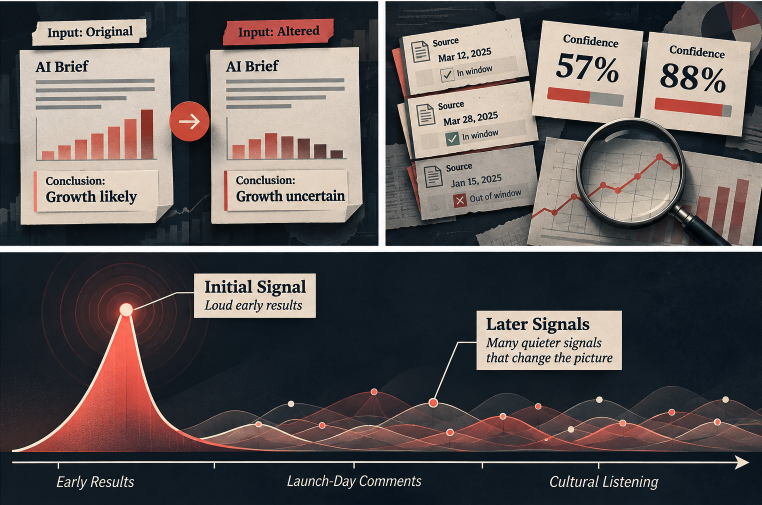
- Flip the key input and see if the answer moves. Give the tool a tie where it had a lead, or remove the strongest data point. If the conclusion barely changes, the tool is leaning on habit, not evidence.
- Make every source show its date. Five of 14 Michigan answers used something from outside the window. In a brand context, that might be a review, a press hit or a competitor move your brief was never supposed to include.
- Treat confidence numbers as a starting question, not a finding. A 57% and an 88% from the same tool may not mean what they look like they mean.
- Ask who hasn’t been counted yet. Early returns looked different from the later count in more than one race. In North Carolina, Cooper had 66.8% of the vote when the AP called it; with nearly all votes in, he’s at 58.8%. In Nebraska, Osborn led the earliest returns before Ricketts pulled ahead later in the night. Early data tends to over-represent whoever shows up first and loudest. That’s true of week-one sales, launch-day comments and the first survey wave. Cultural listening helps because it’s built to hear the slower, quieter signals too.
What this experiment doesn’t prove
- It doesn’t prove AI models are good at elections, or bad at them. Four races on one night, with outcomes that likely moved together, is not enough to judge calibration.
- It isn’t a like-for-like rerun of our June round. Several models ran on free tiers from fresh accounts.
- These are unofficial results, not certified counts, so every score here is provisional. California certifies on December 11, so our LA mayor and governor scores stay provisional too.
- We aren’t naming a “best model.” One election can’t support that.
- None of this says anything about any candidate or party.
One open question
If the same habit is right in Nebraska and wrong in Los Angeles, how would you know ahead of time which kind of race you’re in?
How do I book a call with B3?
Want help pressure-testing your own AI-generated reads? Book a call with our team.
Frequently asked questions
How many of the Senate races did the AI models get right?
Fifty-five of 56 locked predictions picked the candidate the Associated Press later projected as the winner. The models went 14 for 14 in North Carolina, Nebraska and Michigan, and 13 for 14 in Texas. The only miss was Gemini’s no-poll Texas run, which leaned Paxton at 52%.
What does “calibration” mean in plain terms?
It means a confidence number should match how often that kind of call is actually right. If a model says “about 69%” and means it, it should be wrong roughly three times in ten. In this round the average stated confidence was 68.6%, and the models hit 55 of 56. That gap is why we don’t treat the percentages as a precise read on each race.
Why didn’t the leak change the Michigan answer?
All 14 Michigan answers still picked El-Sayed, who is unofficially ahead. The five answers that used the out-of-window Stevens endorsement averaged 65.8% confidence; the nine that stayed inside the window averaged 66.2%. The leak didn’t move the call or the confidence much, which is why a scoreboard-only check would have missed it.
Are these results final?
No. All four Senate vote shares in this article are unofficial projections, re-checked on Nov 17, 2026. Michigan is scheduled to certify on Nov 23, North Carolina on Nov 24, Nebraska on Nov 30, and Texas in a state canvass window of Nov 21–Dec 7. We will update the figures after certification.
About the author
Barika Phillips-Bell is Co-Founder | COO of B3 Media Solutions, Inc., a minority-owned social media analytics and cultural intelligence agency serving enterprise and public-sector clients. She leads B3’s election AI experiment, a public test of how AI models read the same signals and where human interpretation still makes the difference.
Sources
- B3 Media Solutions, Round 2 scorecard, “Election Brand Visibility Diagnostic – Round 2 – Nov 2026”
- B3, “Fourteen AI Answers Agreed on the 2026 LA Mayor’s Race. That Was the Problem.” Nov 10, 2026
- North Carolina State Board of Elections unofficial returns, via Election.org (Cooper 2,480,640, Whatley 1,648,870; 2,626 of 2,626 reporting units; source report Nov 13, 2026, 6:03 PM ET)
- NBC News / Associated Press, North Carolina Senate results (Cooper 58.8%, Whatley 39.1%; 99% expected vote in; re-checked Nov 17, 2026, 10:30 AM PT; figures unchanged): https://www.nbcnews.com/politics/2026-elections/north-carolina-senate-results
- WBTV, “Democrat Roy Cooper wins 2026 US Senate race in North Carolina, AP projects” (AP call at 8:23 PM ET Nov 3; Cooper 66.8% at the call)
- Charlotte Observer, North Carolina certification timeline (counties Nov 13; State Board Nov 24, 2026)
- Texas Secretary of State unofficial election results (Talarico 5,444,982, Paxton 4,249,373; page updated Nov 4, 2026, 4:59 PM)
- NBC News / Associated Press, Texas Senate results (Talarico 55.1%, Paxton 43.0%; 99% expected vote in; last update Nov 16, 2026, 10:00 AM ET)
- Texas Secretary of State, Advisory 2026-28, canvass window Nov 21–Dec 7, 2026; county canvass deadline Nov 17
- NBC News / Associated Press, Nebraska Senate results (Ricketts 50.0%, Osborn 44.1%; 98.7% expected vote in; last update Nov 16, 2026, 12:21 PM ET)
- Nebraska Secretary of State unofficial statewide results (Ricketts 381,045 / 49.9%, Osborn 336,296 / 44.1%; 1,322 of 1,322 precincts; fetched Nov 16, 2026)
- PBS NewsHour, AP Nebraska call at 3:27 AM ET Nov 4 (12:27 AM PT)
- KLKN-TV, account of Osborn leading the earliest Nebraska returns
- NBC News / Associated Press, Michigan Senate results (El-Sayed 52.5%, Rogers 45.5%; 98.3% expected vote in; last update Nov 17, 2026, 10:AM ET)
- Associated Press, El-Sayed projected the winner; Daily Press (Escanaba) report of the AP call at 2:27 AM ET Nov 4 (11:27 PM PT Nov 3)
- Associated Press, “Turmoil in Michigan’s Senate race as Stevens endorses Rogers,” Nov 1, 2026
- Michigan Public, statewide certification scheduled Nov 23, 2026 (published Nov 16, 2026)
- Nebraska Secretary of State, 2026 Official Election Calendar: Board of State Canvassers meets Nov 30, 2026
Update log: Results re-checked Nov 17, 2026, 10:30 AM PT. Nebraska moved since the Nov 16 check: the table now uses the Nebraska Secretary of State’s count (Ricketts 49.9%, Osborn 44.1%); the AP has it at 49.8% to 44.2%. All four Senate results remain unofficial pending state certification. We will update this page when certified figures are available.